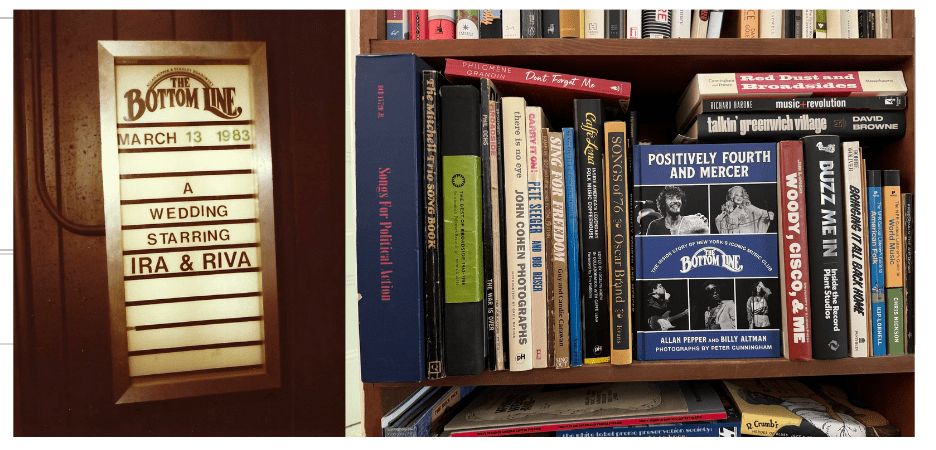
Anyone who was a music fan in NYC between February 12, 1974 and January 22, 2004 has their own Bottom Line stories. I get to share a few of mine in “Positively Fourth and Mercer: The Inside Story of New York’s Iconic Music Club” (Backbeat Books), an oral history by Bottom Line co-founder (and already pre-Bottom Line close friend) Allan Pepper, and journalist Billy Altman.
When he interviewed me for the book, Billy asked for my favorite shows. I rattled off several — most notably Neil Young’s 2 am solo guest set — but my personal standout that understandably didn’t make the book was Riva and my wedding reception. We wanted music — and lots of it, with multiple genres rotating all afternoon. Where else could have accommodated six stage changes with minimal down time between sets? (For the record, we had a chamber trio, a bluegrass band, and the Widespread Depression Orchestra, a swing band.) Most of the scores of anecdotes in “Positively Fourth and Mercer” are almost that personal.
Allan and co-founder Stanley Snadowsky’s joint career as impresarios started with the creation of the non-profit Jazz Interactions and subsequent tours-of-duty booking the Village Gate and Folk City before opening their own club. Their tenure overlapped my years (1970-1990) reviewing live music mostly for the Village Voice, the New York Post and the Soho Weekly News.
One afternoon in mid-1973 Stanley called and said they wanted to show me the space they finally found for the club that had been Allan’s dream — and was increasingly Stanley’s as well. There was only one problem: There was no electricity; we would have to use flashlights so we wouldn’t trip on the peanut shells on the floor and we would all have to wear hard hats. Oh, and I would have to sign an indemnity form in case I got hurt. Well, who wouldn’t be up for that adventure?
We went in, and Allan pointed to the fire engine that had been the stage at the Red Garter, the former club on the site. That was definitely going. The bar would stay but be cut short to make room for dressing rooms. And so on.
As told in the book, I danced with Allan’s wife Eileen opening night. Over the next 30 years I spent many, many nights at Fourth and Mercer with Allan, Stanley, the Bottom Line hosts, waitresses, local DJs, fellow rockcrits, music biz and PR types, musicians, bouncers, and paying customers whose recollections Billy weaves into an impressively coherent narrative (yes, even some of the paying public get their say).
The book could easily be three times its current 268 pages. The acknowledgments thank 35 “additional people who volunteered to share their memories” beyond the 92 (plus Allan and Stanley) actually quoted. And as I say, everyone has their own recollections of special nights with Bruce Springsteen, Dolly Parton, Elton John, Leo Sayer, Henny Youngman, Christine Lavin, the McGarrigles, the Roches, David Bromberg, Roseanne Cash, Jean Pierre Rampal, Peter Allen, Ravi Shankar…the list goes on. When I asked our now-adult son his favorite shows (Allan always generously welcomed his friends’ kids into the club), our son said, “Almost all,” and instantly cited 22 performances, most in some detail. Many of my friends can do the same.
If you were around during this touchstone musical era, “Positively Fourth and Mercer” will spark incredible memories; if you’re a music fan and weren’t around, it’s a very unique slice of New York music history. There isn’t likely another club of the Bottom Line’s influence and significance to come: Music has changed, the live entertainment business has changed, and the chemistry of Allan+Stanley isn’t replicable.
“Positively Fourth and Mercer” recounts the great times, the good times, the unsettling times, the shenanigans, the drop-ins, the backstage (such as it was, with possibly the two smallest dressing rooms anywhere) craziness, the frugality (for which Allan and Stanley are teased throughout the book and for which Loudon Wainwright III has the final say), the tight tables that were a nightly challenge for the black-leotard-and-apron-clad waitresses, the very unique partnership between Allan and Stanley, and the roles both Stanley and Eileen played in making Allan’s dream possible. As DJ Meg Griffin notes, the club’s demise was sad, but what a 30-year run it was. And thanks to Allan and Billy, and a smattering of house photographer Peter Cunningham’s photos, that run is now duly documented.
POSTSCRIPT: A decade after I stopped reviewing Riva and I had a newsletter publishing company that also ran conferences about entertainment marketing, licensing and merchandising, and consumer research. Our offices were on Mercer just below Houston St., literally two blocks from the Bottom Line. So when looking for a unique venue for a series of conferences we approached Allan and Stanley and ultimately rented the club for five back-to-back daytime events that had to end by 4:30 to leave the crew time to re-set the room for those evenings’ performances. The first conference on a Monday worked wonderfully. The second, the following day, was Sept. 11, 2001. The view south on Mercer was of the World Trade Center Twin Towers, which fell as our first speaker took the stage.
 nightmayer