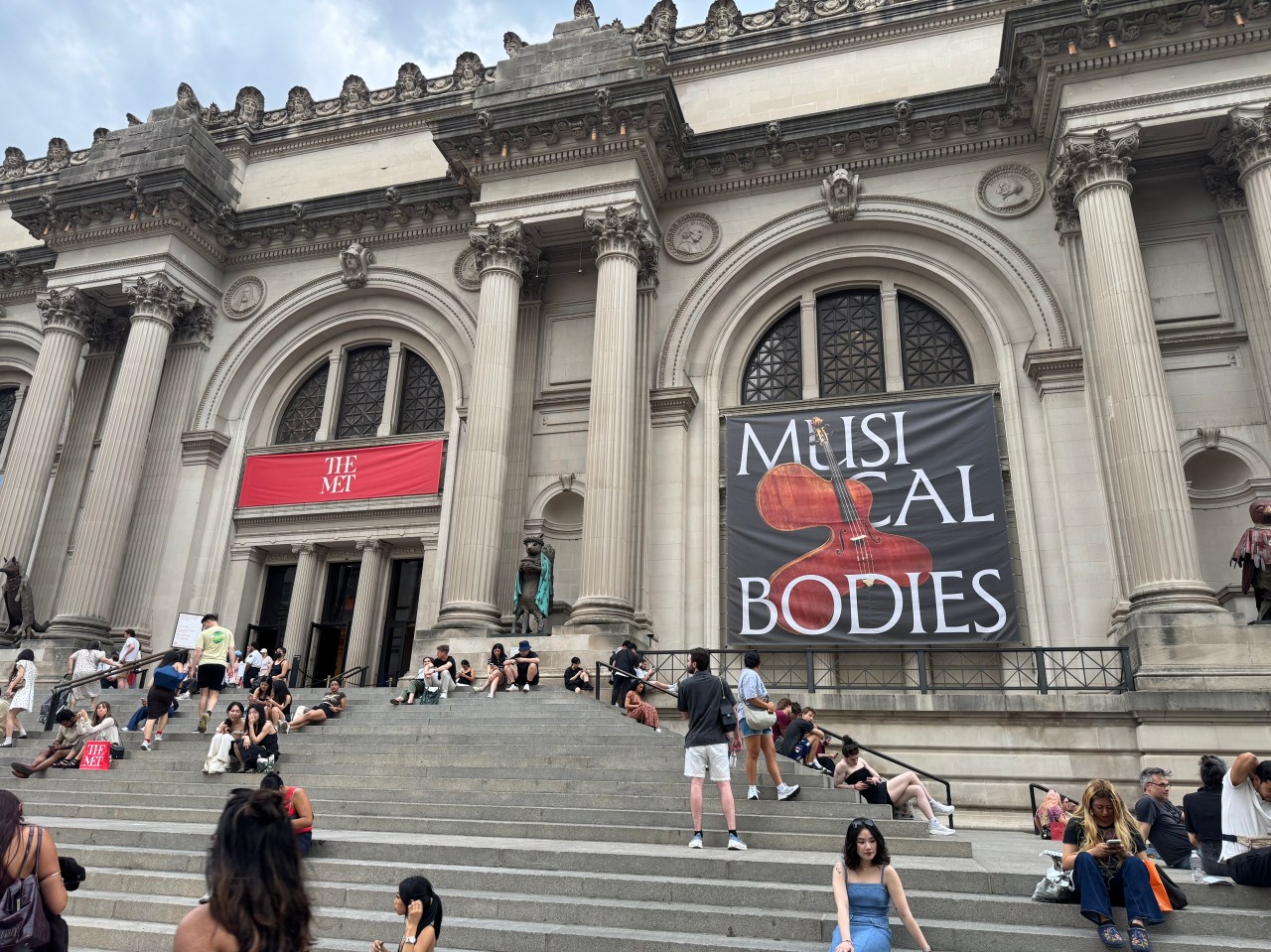
Be prepared to be delighted at the Met Museum’s “Musical Bodies” exhibit, on view through Sept. 27th. Be forewarned: It may leave you feeling randy. Near the end of our visit on the member preview Saturday night, with few people about, we literally danced on the floor keyboard, making music of our own bodies.
From 3500 year-old Egyptian flappers (forerunner to our musical spoons) to Prince’s Purple Rain glyph guitar, from Congolese drums to a 15th Century Guidonian hand illustrating pitches along the knuckles in a 3-½” x 2-½” music book, from cellist Charlotte Moorman’s 1960s video collaboration with Nam June Paik to fantastically inlaid instruments, tapestries, drawings, Titian’s portrait of Venus and a lute player to, well, on and on.
That doesn’t begin to convey the breadth of what isn’t a huge exhibit but is a daring one, full of erotic playfulness and cheeky references along with more “expected” museum-like displays. The index to the catalog (the catalog includes roughly 100 more pieces than are in the exhibit) lists “phallic shapes or associations” 19 times: “electric guitar…penis whistle key ring…gongs of Vanuatu.” “Breasts, female” are cited 10 times: “bagpipes depicted as angel’s bosom…siren lactating on lira da braccio…”
I’m being playful and cheeky myself here; this isn’t the Museum of Sex — it’s the Metropolitan Museum of Art and all is duly dignified. Still, you may never look at a violin or flute or gong the same way again. What fun!
Coincidentally I’ve been reading Eleanor Chan’s “Duet: An Artful History of Music,” which is exactly what the subtitle suggests: A history of the visualization of music. Degas, sure (naturally enough he’s represented at the Met, too, yet Chan’s discussion is very illuminating). Sheet music as art, yes. Sexual connotations aplenty—hello Louise Bourgeois. Even references to Taylor Swift and Beyonce.
Chan is both musician and art historian and, importantly, a fan of both music and art in all their guises. She imaginatively reconstructs scenes inside ancient caves and shares personal anecdotes of her curtailed career as a flutist and, later, singer. There are that Guidonian hand that is on display at the Met explained in detail, a vivid history of musical notation, and a host of what today seem like oddball (and failed) systems for visualizing music based on aromas and colors, to name but two.
“Duet” only came out this year, so presumably wasn’t available to the curators of the Met exhibit; it makes a great companion to what’s on display on Fifth Ave., though, and to the catalog. It’s also available at the Met Store and kiosk outside the exhibit.

