nightmayer

Jottings from a pop culture junkie

BROOKLYN, NY; February 6, 2019—Israel G. Young, founder and proprietor of the Greenwich Village Folklore Center from 1957-1973, and the Folklore Centrum in Stockholm from 1973 through the end of last year, died Monday at home in Stockholm. He was 90.

Izzy was a mentor to this budding writer even before I started contributing to the Village Voice in 1970. Before he left for Sweden, he entrusted his scrapbooks to me in part because he couldn’t afford to ship them to Sweden and in part out of hopes I could turn them into a book, find a publisher and split the income with him.

When the book project proved fruitless, I shipped the scrapbooks to him in Sweden around 1975. The American Folklife Center of the Library of Congress acquired the scrapbooks, Izzy’s journals, and other materials in December 2015.

The article below ran in the Village Voice about a month before Izzy left for Sweden.

Folklore Center loses its center

Izzy Young Looks to Sweden

by Ira Mayer
Village Voice — April 26, 1973

There are 19 tabloid-size volumes of scrapbooks which tell a good deal about the Folklore Center from 1959 to 1969. One has a copy of Bob Dylan’s 1962 composition, “talking folklore center,” copyrighted under the Folklore Center name, with a note in Israel Young’s handwriting underneath the sheet music page: “I published this originally to establish the Folklore Center trademark.”

There are hundreds of newspaper and magazine clippings throughout the books, along with birth and wedding announcements, drawings (usually by Izzy’s lady of the day), letters, poems by people who dropped in the store and felt like writing something, Izzy’s notes on the people who dropped in the store, and some of the “gossip off the street.” Most of the notes and gossip would eventually become Izzy’s “Frets and Frails” column in Sing Out!

The highlight of the scrapbooks is an entire volume devoted to the riots in Washington Square Park, when the city of New York decided that folksinging with stringed instruments was not for its parks. A Daily Mirror frontpage headline of April 10 1961, reads proudly, “3000 BEATNIKS RIOT IN PARK.” There is a 43-page official appeal to the New York Supreme Court, “In the Matter of the Application of Israel G. Young, Petitioner-Appellant against Newbold Morris, as Commissioner of Parks of the City of New York, Respondent-Respondent for an order pursuant to Article 78 of the Civil Practice Act to review his determination and to direct him to issue a permit.” By May 15, Mayor Wagner had intervened with a compromise suggestion that the singers and instrumentalists limit their activities to the hours between 3 and 6 p.m. IMG_1676
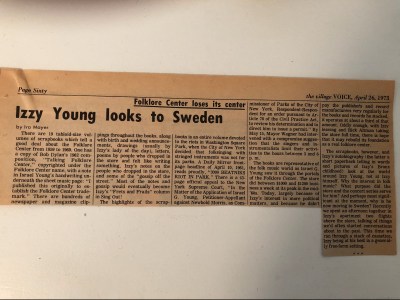
The books are representative of the folk music world as Israel G. Young saw it through the portals of the Folklore Center. The store did between $1000 and $1200 business a week at its peak in the mid-‘60s. Today, largely because of Izzy’s interest in more political matters, and because he didn’t pay the publishers and record manufacturers very regularly for the books and records he stocked, it operates at about a third of that amount. Oddly enough with Izzy leaving and Rick Altman taking the store full time, there is hope that it may rebuild its foundation as a real folklore center.

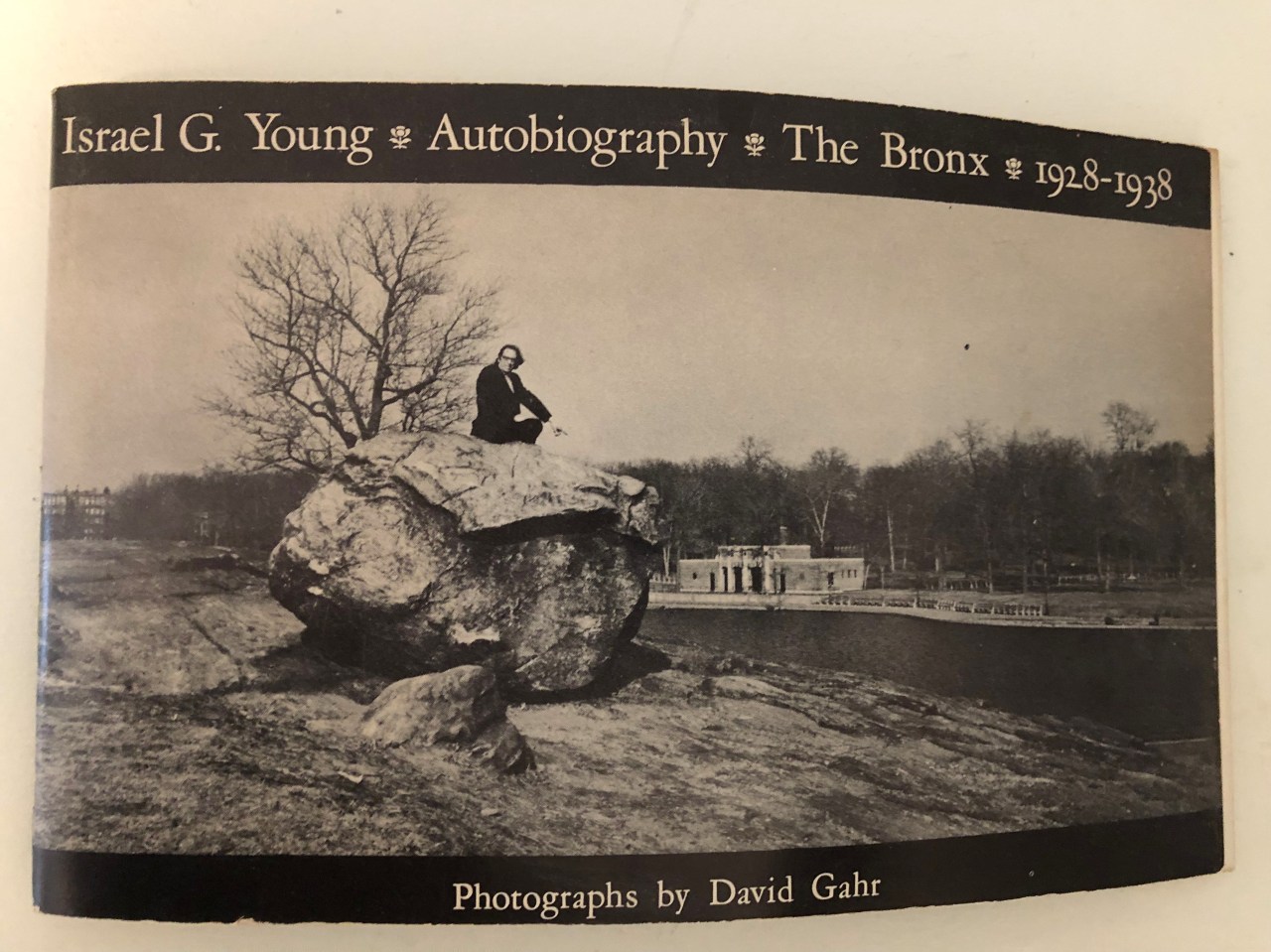
The scrapbooks, however, and Izzy’s autobiography (the latter a short paperback telling in words and pictures of Izzy’s Bronx childhood) look at the world around Izzy Young, not at Izzy himself. Why the interest in folk music? What purpose did the store and the concert series serve for him? And perhaps most significant at the moment, why is he now moving to Sweden? Recently we spent an afternoon together in Izzy’s apartment two flights above the store, talking of things we’d often started conversations about in the past. This time we ran through a stack of cassettes — Izzy being at his best in a generally free-form setting.

* * *

“I’ve been working in the United states for more than 20 years,” began Izzy, “working on this original idea that I picked up first from square dancing, and then from Margot Mayo’s group, that folk music is the heartbeat of a person. I followed that idea in mind, even though I never followed it completely in my work. I’ve never been a real scholar or a real ‘thing’ in the U.S. I just kept alive a certain idea – which everyone agrees with, but no one agrees with my practices.”

The practices in question, he says at first, are a matter of a lack of direct control. Yet Izzy is the first to admit that the Folklore Center has been a one-man show, run on a “cash-in-pocket” basis, so that the store could support the concert series which in turn could support the store, both of which could support him. The economic end is where he lost many of his supporters in the folk music world.

“If the folklore Center concert series was really economic, a lot of people would want to be attached to it, people who are concerned about security for themselves and their own names. Instead they work for the foundations or the folk festivals. Or they are scholars in universities. Or they join the Smithsonian Institute. or the go after grants.” For those familiar with some of the inner goings-on in the folk world, each of those alternatives has a name or two attached to it. As for grants, he himself received one from the New York State Council of the Arts this year, of which he says, “It was sort of like an accident — it wasn’t like it was planned. But I find myself being left a little bit out in the cold because of the way I work things.”

The concert series has been run on the basic premise of a 50/50 split with the artist. With a $2 admission charge most of the time, the majority of concerts attract an average of 100 people. A little bit of stealing from the rich and giving to the poor became the policy when one performer would draw 500 people and someone else at another time would attract six. “I’ve played that role in the field, not that I wanted to. It’s as if I’ve joked about it: I hit people on the way up and on the way down. In the middle the situation is that people don’t want to work on my terms.” Two names come up: John Cohen, of the Putnam String County Band, and John Herald.

“When John Cohen needs me to show a film, he calls me up. When he doesn’t need me for a film I don’t see him, even though he’s my friend. Last week he told me how he didn’t see why he should put the Putnam String County Band on in my series, while two months ago he thought it was very important . . . And I’ve asked John Herald for years to do a concert for me. At Gerde’s or the Bitter End there’s still a dream that you can make [it]. It’s a scene. The Folklore Center has not become a scene in 15 years.”

For a while it seemed as though there was a “scene,” a time when any new singer or songwriter needed New York City (and the Folklore Center as an outlet in the city) in which to grow up. “Dylan, Paxton, Ochs, Odetta all came to New York. At one time I was in a fortunate situation. The whole folk music movement was there. Pete Seeger, the American Square Dance Group, the leftists, and the conservatives.” Was there much of a conservative constituency? “Well I was pretty conservative myself. At first, when I took in the ‘People’s Song Book’ and ‘Lift Every Voice,’ I was against them. I felt I was being democratic by stocking them in the store. I felt there was no reason to change the country’s tradition for what you wanted to accomplish. I was against Joe Hill’s rewriting church hymns. But of course the people who wrote church hymns didn’t mind at all changing the text for their purposes. Everyone was using music to get their ideas across.

“I became a part of that scene with many others. The only difference between me and the others was that I wasn’t a musician. And yet, because of the way I acted, I was the only one who could go into meetings and conferences for folksingers and always be treated as a folksinger. I was usually the secretary or president of something, and nobody ever said, ‘Well Izzy doesn’t play guitar or banjo or sing. What right does he have to be in this room?’ . . . That was a screening out process. A few people making it and somehow the rest still digging in and saying it’s important. A co-op group or a protest committee. And then it fell out.”

The scrapbooks, too, drift off temporarily at that point. The civil rights movement had peaked with the March on Washington in August 1963. The marching was literally over for the time being, and most of those who had “made it” returned to the comfort and security of concert stages and coffee houses. “They got their medals when they went (down south),” says Izzy. “Phil Ochs would take a chance he might get killed when he went to Mississippi to sing . . . But he would go into a town, spend three hours, sing some songs, work up the populace, and then leave and maybe make it more dangerous than it was before.”

“But where were all these people from the civil rights movement in the vanguard of the anti Indo-Chinese war? Now if you talk about that to singers, they generally say. ‘There’s no communication.’ How come there was communication in ’63 but not in ’73? Because the artist now knows his place much better. Judy Collins is now on the cover of Ms. magazine, which is pretty wild. Ms. is a very false, cheap copy of any civil rights thing she might have stood for in 1964 and some rallies she sang at in 1969. And Mary Travers sings some protest songs. But she’s very clear to point out that it has nothing to do with real protest. It’s just a feeling of people that somehow things will happen without anybody having to give up any money or blood for it.”

The politics of folk music. We disagree fundamentally as to whether every singer is necessarily political, Izzy insisting that “every singer on stage is presenting a political opinion,” either as a “general premise,” as with Michael Cooney, or very directly, as with a Barbara Dane. Forcing the issue, as Barbara Dane does, or “antagonizing” people as Jane Fonda does, however, are no longer successful. “Even Joan Baez, who doesn’t have the political savvy to get her songs across. But somehow Mary Travers does, even if it’s the same songs. What people are saying is that they don’t want to hear real protest songs any more.”

For the last two years Izzy’s newsletters (which come out about every three weeks) have included a column of news and comment on Cambodia, a column to which he has gotten very little response, “except that Rick says some of the people at the concerts say it’s a shame I’m mixing up the concerts with Cambodia. I feel it’s a very unique box that Cambodia’s in and it hasn’t stopped the concerts. Though on the other side you can say that if a singer sings for me they’re in a sense approving the things I’m writing in my newsletter. But I’ve never heard a singer say that to me.”

To be sure, many of the singers do not feel as Izzy does, about Cambodia or music, as two cases illustrate very well. Prior to her first appearance in New York, Izzy had written a vehement attack against Joni Mitchell in the pages of Sing out! Joni Mitchell’s first New York concert took place shortly thereafter – for Izzy Young’s Folklore Center concert series. Then in 1965, when Sing Out! took a stand against the war in Vietnam, a dispute arose when John Cohen objected to Sing Out! people, specifically Barbara Dane, writing to Roscoe Holcomb about the war. “She said at the time,” Izzy recalls, “I think rightfully, that he’s as much a part of the war as we are. And he has thoughts about it.” All three of these people have appeared on Izzy’s stage at various times before and after this incident.

* * *

One of Izzy’s pet peeves of recent months has been the singer/songwriter syndrome, and the dozens of kids who come to the store every week seeking auditions. They all, he says, do only their own material, sound like James Taylor or Neil Young or Joni Mitchell, never come to concerts by anyone else and generally have no knowledge or regard for traditional music. To a large extent, he blames the major record companies for the situation:

“When Elektra was recording folksingers 20 years ago, they had a balanced idea of making a living out of the whole label. Some records sold better than others, so Theodore Bikel got more money than Cynthia Gooding, and Ed McCurdy had one album which sold very well and kept him alive for a long time. But everyone knew each other on the label. I’ll bet now that there are 20 times as many people on the label who don’t know each other . . . And it doesn’t make a difference anymore if you’re on Paramount or Columbia . . . At one time, all new records that came out on Elektra or Vanguard were automatically heard.”

That the audience is more diffuse now as a factor he wished to set aside. “As soon as they found out about hype,” Izzy continued, “and that they could sell a lot of records with hype, they gave up on the old idea that the artist is important by himself. And that’s when all these phony recording contracts came out where the artist wasn’t protected, where the artist paid the entire cost of the recording . . . The companies were in a position of laying out money in terms of investment, but they were willing to take the chance of putting out maybe 100 albums and waiting to see which one made it. When one did make it, they were still ahead.”

Folkways, Folk-legacy, Rounder and County, among other small record companies, have all been doing increasingly well in recent months, and I suggested that this, as with the rapid increase in the number of small folk music clubs and folklore centers (about 20 of the latter are spread throughout North America), is due to the personalized environment in which each operates. Izzy agreed, but saw the next necessary step in the live idiom as greater cooperation among those running things.

“Someone like Janet Schneider is coming in — with some big ideas that’ll come down soon — but she put together several thousand dollars worth of gigs for Aly Bain and his group. She did better than a commercial manager could do. Or the Philadelphia Folk Festival. I’ve arranged 10 concerts in 10 minutes through that. There can be more cooperation, but it should be better organised . . . Philly is going to have a musician from Gambia this summer, and we’re going to put him on and the Folk Music Society of Northern New Jersey is going to put him on, and altogether we hope to raise $3000 to $4000 through a tour so he can buy a house in Gambia and live with his family. When something special like that comes along we can do it. It’s when it’s a singer who’s not that special that people don’t call and say ‘Let’s get a tour going.’ And I’m included in that.”

At 45, Izzy is surprisingly objective about his own role in “the New York folk scene.” Though he’d like to see more cooperation, and a more socialized mode of operation, he is acutely aware of the need for one central figure in any organization. Internal strife among factions at publications such as Sing Out! and the Guardian, he points out, have held them back from their full potential, and true performers’ cooperatives have either failed completely or metamorphosed into large corporations. All of which is part of why he now wants to move to Sweden. “Originally it was this love of Swedish music, though that’s obviously not the reason for leaving the United States,” he says. “I don’t know what’s going to happen in Sweden. One of my plans is to be able to work more cooperatively there than I was able to here . . . I’d like to be part of something where the musicians control the dance music scene themselves rather than business people . . .

“At the moment I feel Sweden is a backwater place and that there’s a lot of good cultural things that come through which could make it in a few years much more exciting than New York — and much more healthy, because more people are really interested in what’s going on . . . I’ve gone to many new things in Sweden and have never seen something like here where there are 10 or 12 people at poetry readings. If you present a concert of foreign music in Sweden, you can be sure that there’ll be a decent amount of people to hear it, and that they’ll probably get on radio and TV and get paid for it, as well as get a certain number of concerts with musicians —easy gigs where they play for half an hour a night.

“Cyrelle Forman was here recently, and she told of three places to sing in Stockholm. She was there just a short time and she sang at all three clubs. I challenge a Swedish singer, or a French or Scottish singer, to come to New York City and sing at the Folklore Center, Max’s, Gerde’s and Gaslight after being there for three weeks. Even English singers can’t get heard here.”

* * *

We touched on a number of other things that afternoon. The third floor apartment is going to Ed Diehl, who’s been the guitar repairman in residence at the store for the last year and a half. Izzy will try to continue his twice-monthly radio show for WBAI from Sweden (“it’s one thing I still really enjoy doing in New York”). There were some not too kind words for The Voice (“The articles have been on the pains of middle-class people getting mugged or not getting mugged, of ‘lets get our thing together and get dog shit off the streets, and of more plants in windows . . . and pages of rock ads and barber ads for $18 a shot.”), and a few more well placed jabs at some of those who have at one time or another considered Izzy their friend.

Some of those friends he hopes to cover in “an alphabet book of American folklore,” something on the order of Lincoln Kirstein’s “Blast at Ballet.” “I was thinking of writing ‘A Fart at Folklore.’ I would write a paragraph about Kenny Goldstein for which he would never forgive me, and about Moe Asch for which he would never forgive me.” Some of those same people, however, are the ones who recently responded to Izzy’s cry for help when the City Tax Bureau padlocked the store.

“I think there’s a general understanding among people that you get $50 for an article here, and I get my $50 in subterranean ways, and meanwhile I won’t stop anybody from giving me money from whatever they’re doing. I’m forced to ask for handouts from people who have money now, which is something I’m ostensibly supposed to be against. Everyone’s supposed to earn their own way and everyone’s supposed to be equal.”

Israel G. Young is more of a realist than he’d like most people (and perhaps even himself) to believe. He’s even realistic about the fact that the Swedish government seems unlikely to issue immigration papers for Catherine and him before they leave this country, and they’ll have to fight for them once they’re in Sweden. But that opinion is no more “outrageous,” as he likes to put it, than any of the others offered above or over the last 17 years.

End of Village Voice article. Click here for Izzy’s obituary in The New York Times.

OCT. 23, 2018—We should have known to trust Young Concert Artists. Now in its 58th year introducing young classical musicians and vocalists, most of  the artists have both technique and character. Occasionally, we’ve heard someone who was technically excellent without connecting emotionally with the music. But a classical accordion player? What has history led us to expect? Astor Piazzolla was the exception; Lawrence Welk sticks in more memories.

Hanzhi Wang, who made her NYC debut last night at Carnegie’s Zankel Hall, was a delightful surprise, no fretting warranted. From the opening Bach Partita in C-minor (see an earlier performance here) through to pieces written for her by Danish composer Martin Lohse, whose work is at the heart of her first LP (listen on Spotify here), and Sophia Gubaidulina, this was a musician of stunning skill and heart.

Hanzhi’s bio says nothing of how she came to be enamored of this instrument or music, studying as she did in her native China, then in Denmark. But her soul is clearly born to it. Mind you, I had to take a nap after every accordion lesson — the instrument was almost as big as I was at 10. My last “performance” was 20 years ago, arriving at friends’ New Year’s Eve party scratching out Auld Lang Syne. Hanzhi Wang, in her 20s, takes the instrument — and her listeners — to fresh depths.

It’s the right confluence of events with:
 
• The Village Trip celebrating the arts in Greenwich Village Sept. 27th-30th;
• Girl From the North Country, a wonderful Conor McPherson play with a Depression Era theme that is brilliantly enlarged by some 20 Bob Dylan songs having just begun performances at the Public Theater; and
• Judson Dance Theater: The Work Is Never Done on-going through Feb. 3rd at the Museum of Modern Art;
• Artist David Wojnarowicz’s retrospective at the Whitney and NYU Bobst Library.
 
While there are a few tickets available for Girl From the North Country’s limited run at the Public (it is expected to move to Broadway), there are plenty of opportunities to partake in The Village Trip, and time to take in the Judson and Wojnarowicz exhibits, but the focus here is on The Village Trip.
 
The Village Trip is a labor of love by Liz Thomson, a British journalist and an editor who worked with the late Robert Shelton on his 1986 (and the much later update) Dylan biography, “No Direction Home.”
 
Shelton’s original NY Times review of Dylan’s first appearances in the Village certainly focused a spotlight on that boy from the North Country of Minnesota, which is where the McPherson play takes place.
 
Liz may have lived in London, but she was and remains a Village folkie at heart. And she couldn’t have anticipated when she first started telling me and others of her dream of a “Bringing It All Back Home” festival she wanted to stage in Washington Square Park to celebrate that Dylan album’s 50th anniversary that the Village would be celebrated in so many ways this fall.
 
The anniversary came and went, but Liz enlisted Liz Law as her Stateside executive director and many trans-Atlantic trips later the two have built on the original concept which now incorporates not just folk, but the Village relationship to jazz, drama, poetry, and more.
 
The result is a series of free and paid concerts, guided walks, lectures, exhibitions, and more coming up Sept. 27-30 at various venues including Washington Square Park (Suzanne Vega headlines), the Bitter End (Happy Traum, Tom Chapin, David Massengill, and others), the New School (David Amram and others), and other locales.
 
Artist-in-residence Amram was and remains active in many of the arts being extolled, and much as he hates the term, is a key link between the “Beats,” the folkies, and the classical world.
 
Get tickets for Girl From the North Country if you can. You will be moved, and humbled, and amazed at the underlying meanings no one could have anticipated for the Dylan catalog. The MOMA Judson exhibit reflects another facet of the Village’s thriving arts scene. And the Wojnorowicz exhibits are harrowing but representative of a later downtown (and outsider) era. Most immediately, though, sign on for the various events that are part of next weekend’s celebration of The Village Trip. The Dylan, O’Neill, Millay, and Kerouac spirits will be thriving there, too.


There hasn’t been a Village Voice like the one that I had the privilege of writing for in the 1970s for many years. As for many writers, The Voice gave me my start as critic and journalist — thank you Diane Fisher, my editor, wherever you are. I’m saddened by today’s announcement that the Voice is ceasing operations entirely (it stopped publishing a print edition last year). One fewer option for journalists looking to find their own voices.

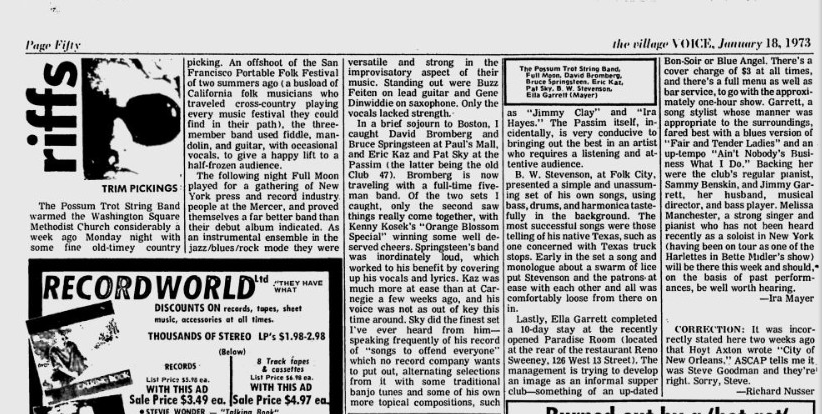
January 1973. In Boston to see David Bromberg at Club Passim. The opening act is Bruce Springsteen, of whom I write in the Village Voice, “Springsteen’s band was inordinately loud, which worked to his benefit by covering up his vocals and lyrics.”

Riffs Jan. 18 1973

Summer 1974. At a pool party hosted by the publisher of Record World magazine, for which I am now an editor. At this tony weekend home in Wilton, Connecticut, I introduce myself to the legendary talent scout/producer John Hammond, a neighbor of the publisher. Hammond is acknowledged as “discovering” Bob Dylan, Aretha Franklin, Billie Holiday, Bruce Springsteen, and many others. “I know who you are,” he says to me, cutting me off and looking me in the eye. “And Bruce agrees with you about that night in Boston. But he promises you will eat your words.”

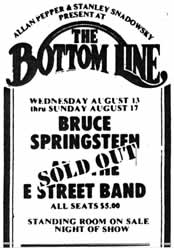
August 1975. I attend at least two, maybe more of the legendary Bottom Line shows that kicked Bruce Springsteen’s career into high gear. Saw him in between, opening Upstairs at Max’s Kansas City for Biff Rose, and by late 1973 as a headliner at Max’s. But the Bottom Line shows, one of which was broadcast live on radio, and which coincided with release of his third album, Born to Run, were the spark of ignition.

Screen Shot 2017-11-01 at 3.05.14 PM

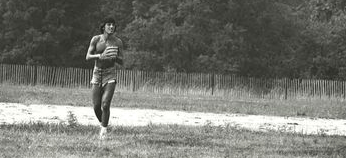
I never had the balls to introduce myself when I had the chance. Working at Record World, I was also “team photographer” for the Record World Flashmakers softball team. Summer of 1976 the team went out to Redbank, New Jersey a few Saturday mornings to play the E Street band, including Bruce. Among the photos I took was one of Bruce at bat in cut-offs and sneakers. The art director at Record World superimposed an image of Bruce’s guitar over the bat and presented it to him. (In the photo above, Bruce is playing second base.)

There were also shows at the Redbank Theater that stand out. The band vamping quietly behind him, he stood in the spotlight and told stories about his father that were harrowing, clearly for him as well as the audience. But it was raw and honest and vulnerable. “Folkies” at that time could do that sort of thing, but rock and rollers?

Plenty of concert hall, arena, and stadium shows later, some of which I review, many of which I attend simply as a fan, indoctrinating our children over the years into the cult of Bruce.

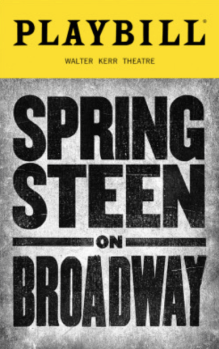
Screen Shot 2017-11-01 at 4.24.35 PMOctober 2017. Springsteen on Broadway, the brilliant distillation of a career which I see this night with my now 31-year-old son who remembers every Springsteen show he has seen, where he (sometimes we) sat, and most of the playlists. Unlike Bob Dylan, whose shadow hovered over Springsteen for many years, and who revels in often changing his songs to the point that long-time fans have difficulty identifying what he’s playing, Springsteen re-works 15 songs to put them in the context of his life, completely familiar but with fresh force, as though you’re hearing — really hearing — some of them for the first time. They are all solo acoustic this night, except for two performed with wife Patti Scialfa. They are embellished with stories, mostly of his childhood and early performing years, delivered while vamping — now doing it himself on guitar or piano — much as he did at the Redbank Theater in the mid-1970s.


A few months after that initial meeting, I am seated next to John Hammond for a concert at Carnegie Hall, and the honorable Mr. Hammond greets me as an old friend, working to put me at ease. I am 22 years old and incredibly appreciative of his kindness and support, talking with me about what I was listening to and writing about.

This morning, 44 years later, I have no doubt that the show I saw with my son last night on Broadway is what John Hammond, who passed away in 1987, saw in his mind when a scrawny 20-something auditioned for him in an office at Columbia Records.

Mr. Hammond, Bruce…my plate is clean.

© 2017 Ira Mayer.

We are in for a bracing year of serious-minded theater in New York City if the first two offerings of the 2017-2018 season at the Signature and Atlantic theater companies are any indication.

The searing Fucking A, by Suzan-Lori Parks at the Signature, one of two “riffs” by Parks on The Scarlet Letter, dates to 2001. [The second of these “Red Letter Plays,” In the Blood, is also at the Signature; will see that later this month.] The “scarlet letter” of the play is an “A” for abortionist; the setting is anywhere/anytime and universal.

Simon Stephens’s tie-your-stomach-in-knots On the Shore of the Wide World at the Atlantic was first produced in London in 2005.  The play traces three generations of a grief-stricken family in what would seem to be genetically-induced emotional turmoil.

Both plays resonate with the graceful language of classics.

The casts are excellent, as is the direction (Jo Bonney, Fucking A; Neil Pepe, On the Shore). On the Shore could use trimming and refining in the second act, and several of the American actors would do well to tone down the British accents, but that shouldn’t stop you. In both cases, be prepared. In your gut.

© 2017; Ira Mayer.

It is not easy to feel great about America right now. But there is an antidote.

My wife Riva and I spent nine weeks this summer on a cross-country trek in our trusty 2005 Toyota Camry with three hubcaps. “We’re from Brooklyn,” said Riva when I wanted to replace the missing hubcap before we ventured out. “I like the look. It says, ‘Don’t mess with me.’” IM-RB Columbia River Gorge

It’s 47 years since I first drove cross-country, camping with my buddy Howard. I had just graduated high school; Howard had finished his first year at Wharton. This 2017 trip was Riva’s first sea-to-shining-sea by car.

As now, 1970 was a politically fraught time in the U.S. The Vietnam War was raging, and it was on that trip that I learned my draft lottery number (206; no need to go to Canada). In the course of the 2017 trip, my Medicare card got activated, and we mostly steered clear of the news and talk radio.

Howard and I had a canvas tent that he recently threw out. Riva and I stayed mostly in cheap motels and Airbnb’s with good shower heads, comfortable mattresses, mini-fridges and complimentary breakfasts — sometimes quite extensive breakfasts, as at Miriam’s b&b in Whitefish, Montana and at the Piccadilly Motel in Radium Hot Springs, BC (yes, we went to Canada this time).

Howard and I visited mostly national parks along the southern route and ate a great deal of canned Chef Boyardee cheese ravioli, heated in the can on our camp stove. Riva and I primarily visited national and state parks and forests in the Pacific Northwest and Canada, shopping for provisions at farm stands, Safeways and IGAs. Typical dinner from our cooler: triple-washed arugula, pulled chicken, and orzo or Greek salad all mixed together.

How to feel great about America?

  • Pay heed to Mary, the ranger in Olympic National Park who, upon learning we wanted to take a late afternoon drive up to Hurricane Ridge, warned that we’d be “driving into a cloud with zero visibility, 40 mph winds, and heavy rains. I wouldn’t go myself.” Instead, Mary suggested a scenic 30-minute drive to Crescent Lake, where we might have drinks on the veranda or dinner at the lodge. We shared an artichoke and soup, and downed a local IPA and a Washington State chardonnay on an enclosed porch overlooking a lake that mirrored the mountains and the clouded sunset. Said Riva, “I could live out my days right here.” Next day, after thanking her for sending us to Crescent Lake, Mary gave us the thumbs-up for the magnificent hike on Hurricane Ridge.
  • Hear Woody Guthrie’s words come to life as you visit the National and State Redwood Forests in northern California. Drive or hike through the Avenue of the Giants and the Valley of the Giants at dusk, when the 300-foot tall trees jump out at you at every curve. Stay at the Curly Redwood Inn in Crescent City, CA, where the entire meticulously maintained 1950s motel is built from and decorated with the lumber produced by a single redwood tree.
  • Circle the Colorado National Monument, 20 minutes west of Grand Junction, Colorado, in the northwest corner of the state. Following the 23-mile Rim Rock Drive yields a stunning landscape of red rock cliffs and sandstone monoliths that rose out of the earth as much as 1.5 billion years ago. One of my favorites, with little tufts of green sprouting from the rocks, resembles Kermit the Frog (look carefully in the lower left corner of the left photo).
  • Celebrate a 16-year-old Mennonite girl in Fairfield, Montana (pop. 724) whose parents hosted us in their Airbnb and who passionately told her big city guests, “Town may only be two blocks long, but it has everything you could ever need.” Elk RoomHer 24-year-old brother had sacrificed his room for our benefit when our plans changed at the last minute — we got “The Elk Room,” complete with three sets of antlers, elk light switch plate, elk sheets, and elk lamp.

  • Turn into every scenic viewpoint or bypass. They are there for good reason. In 12,124 miles, we took most of them — and regretted only those we didn’t see soon enough to slow down. Sometimes we made U-turns to get back to them, as we did after passing a drive-through Lady Bug Bikini Espresso shed in Tacoma and a lavender farm in Sequim, WA (pronounced Skwim).
  • StrawberriesShop local, especially when in season. “Those strawberries? My parents picked them two hours ago,” said the young man running the Esparto, CA farm stand proudly. “The peaches were yesterday afternoon.” We ate the peaches in the parking lot, our chins still dripping as we went back for more. He works the farm nine months a year, then travels the globe the other three months.
  • Listen to the woman in that same parking lot who, overhearing about our trip, volunteered that “the best butcher you’ll ever find is five miles down this road.” That’s a challenge to this son of a butcher, I explain, especially given that we weren’t cooking on the road. “They make the best roast beef sandwiches,” she promised. They did. And then, taking another scenic detour, we happened upon the Featherbed Railroad Bed & Breakfast in Lake County, California, which she’d also recommended. Nine cabooses, each on a small track-bed and each with its own period furnishings.
  • Bring a dedicated camera with good optical zoom as well as your Smartphone to document the bears, elk, big horn sheep, mountain goats, moose (if you’re lucky), birds, bison, and buffalo.

    And use Google or Siri or Alexa to discover how to distinguish crows from ravens, complete with samples of the different sounds they make. Couldn’t do that in 1970!

Each day brought new delights. Just as we might start thinking, “Gee, that was so incredible, nothing is going top it, let’s just start home,” we’d take another detour, hike, or drive and discover another breath-taking waterfall in Yosemite completely unlike any of the others we’d seen. White Cap GeyserOr be among the first to reach the just-cleared-of-snow Logan Pass in Glacier National Park in July. Or witness from just steps away the little-visited White Cap Geyser in Yellowstone which shoots 30-feet into the air promptly every half hour on the quarter hour and is but a few miles from finicky Old Faithful. Or find ourselves laying on a tarp on an open field in Yosemite at 10 p.m., staring at the night sky as a ranger recounts how his mother climbed El Capitan with him, at 18 months old, on her back, starting the process of instilling in him a passion for nature and country.

You don’t have to spend nine weeks or travel across the country for this antidote to work. The genesis of this trip was a series of family and work events that happened to take us NY>Chicago>Las Vegas>LA, in that order, over the course of three weeks.

There were stops along that route, too, visiting Ohio’s Cuyahoga National Park near Youngstown, OH where Riva grew up; getting a quick tour of St. Louis from plein air artist and muralist Allen Kriegshauser and his wife Patti (top row above right is one of Allen’s murals for a classroom at the Museum of Transportation in Kirkwood, MO), stopping for great BBQ at Q39 in Kansas City after visiting the Nelson-Atkins Museum of Art, and so on. Being in LA positioned us to visit the USS Midway and get a fascinating over-in-an-instant five hour private tour of the aircraft carrier by Riva’s cousin/doctor/Midway docent Bob Berns. And then it was Yosemite and north.

What we ultimately learned, as Riva put it upon our return, “We need more green in our lives.” And that can be whatever local park, forest or trail is available, for however long we/you have.

That’s America the beautiful. And that’s easy to feel great about.

Text and photos © 2017 Ira Mayer.

Click here for the Spotify playlist.

In 1967, I was a student at Far Rockaway High School in Queens, New York. I was participating in anti-Vietnam War marches, with Phil Ochs’s sister, Sonny Ochs, who lived nearby, leading the requisite sing-alongs; spearheading a program to convince the community that permitting a Phoenix House drug rehab center in the area would be beneficial to the neighborhood; and walking past Sam Goody’s house nearby — yes, Sam of the then-small New York area Sam Goody record chain — who appeared to be pressing records in his garage. The sting of Mrs. Fink berating our 5th grade class at Beth El Day School for not having insisted our parents takes us to the March on Washington to hear Dr. Martin Luther King was still fresh. I wasn’t going to let these latter-day movements pass me by.

Clearwater 1969

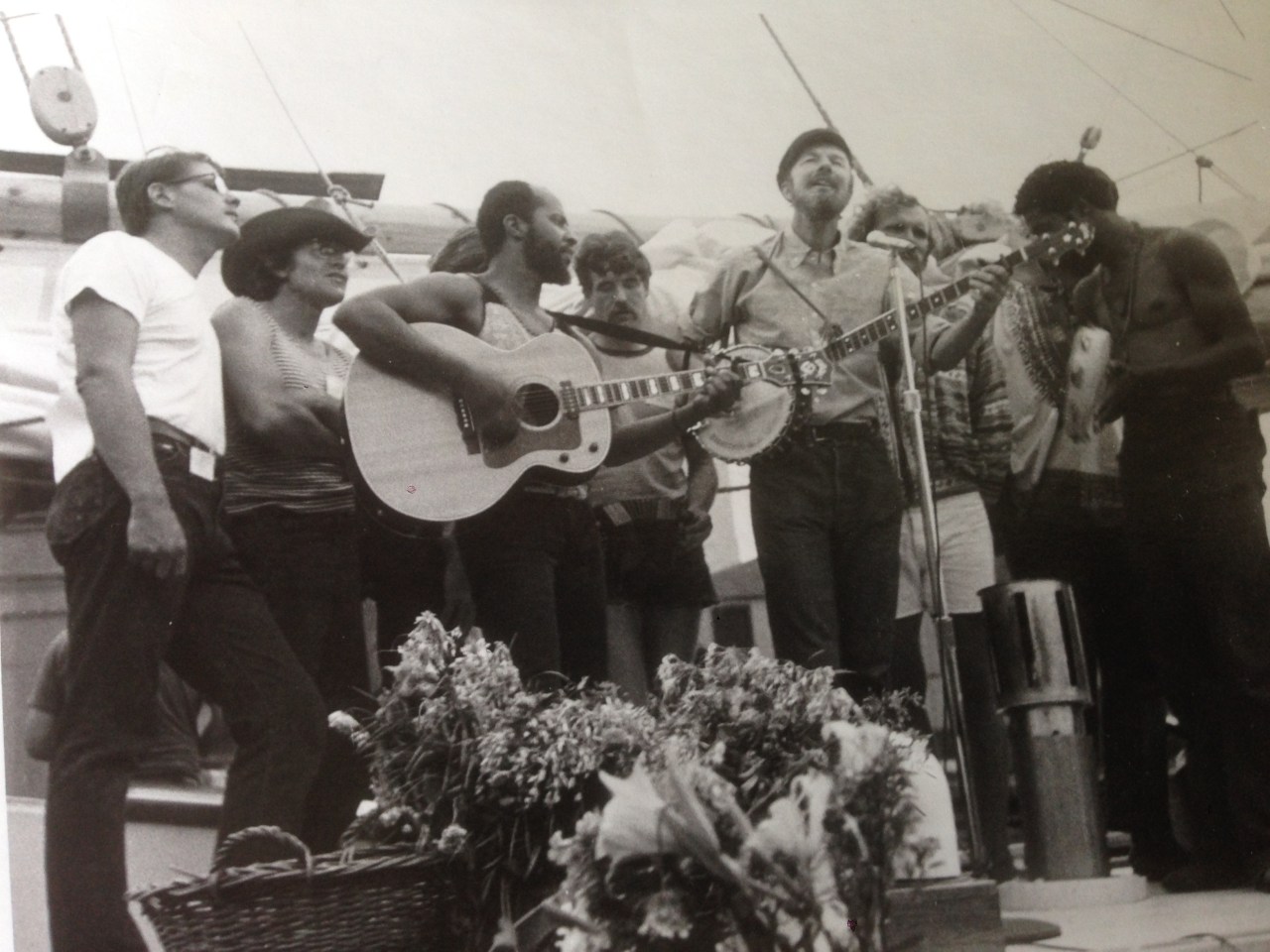
On the Hudson River sloop Clearwater, at Newport, RI, for the 1969 Newport Folk Festival. From left, Gordon Bok, Ramblin’ Jack Elliott, Len Chandler, Lou Killen, Pete Seeger, Jimmy Collier. Photo © Ira Mayer

I was already a pop culture junkie and opera lover, attending concerts at Izzy Young’s tiny Folklore Center, by then on Sixth Ave. in Manhattan (now in Sweden), Carnegie Hall, Brooklyn College, the Brooklyn Academy of Music and elsewhere. Apart from maintaining a journal, I started reporting on my escapades in the Rockaway Wave, which had bestowed a weekly column on me to write about high school. That happened to be the year of a city-wide teacher strike (two weeks in the fall of ’67, and then May through November of ’68). I had space to fill, and music and theater fit the bill as far as I was concerned. Conservative as the editors no doubt were personally, they left me to my (de)vices and published my early reviews.

That’s about when I started compiling my own songbook, pulling together the civil rights, anti-war and general social commentary songs that drove a budding liberal’s heart, guitar and banjo. I transcribed the lyrics by hand from LPs I purchased from the 25-cent cut-out bins at discount department store E.J. Korvettes, and, at substantially higher prices, at Sam Goody’s; at G. Schirmer’s, which specialized in sheet music but where you could listen to an album in a private, phone booth-size “room” before purchasing; and at Discophile, a basement record shop on W. Eighth Street in Greenwich Village known for its classical music imports.

Transcribing the lyrics meant picking up the tone arm on my turntable and putting it back down dozens of times for each song, then playing each back and editing. Occasionally I was lucky, and one of the songs was published in Sing Out! or Broadside, two earnest left-wing “folk music” magazines — though what constituted “folk” in a newly energized world of singer-songwriters was an on-going debate. Sing Out!, founded by Pete Seeger, Irwin Silber and others, and Broadside, run by wife and husband anarchists Agnes “Sis” Cunningham and Gil Friesen out of their apartment on the upper West Side of Manhattan, were open to anything left of left and an antidote to fan magazines such as Hit Parader, which published the lyrics to AM radio’s top 40 hits. There were also songbooks featuring early works of Tom Paxton and Phil Ochs.

When I arrived for freshman orientation at Hunter College, part of the City University of New York, in the summer of 1970, one of the elevators had just been tear-gassed as part of an anti-war protest. I’d entered from the Lexington Ave. side of the building so didn’t realize the school had been evacuated and my fellow students were all on the median on Park Ave. I wrote about the experience and mailed the article to the Village Voice, a weekly “alternative” newspaper. They weren’t interested. But shortly after, Bernie Klay, who ran the Sunday afternoon bluegrass and old-timey music concert series at the 23rd St. McBurney YMCA took me aside before a Doc Watson concert.

Bernie, like Izzy Young at the Folklore Center, had been letting me in for free as “press” thanks to my high school column in the Wave, taking care of me as they took care of many others, I would eventually learn, from the meager receipts of the concerts they produced that would attract anywhere from 12-150 people.

“Ira, it’s very nice that these reviews you write are in the Rockaway Wave, but how about trying the Village Voice or somewhere people will see them?”

“Who do I send them to?”

“Diane Fisher. 80 University Place. She’s the editor of the Voice music reviews.”

I wrote a review of the Doc Watson concert that Sunday afternoon and took it over to 80 University Place, where I pushed it under the glass door (the paper was closed weekends). That Wednesday I bought the Voice as I usually did — only this time, there was my review.

I went to something the following week (a Joan Baez concert, if memory serves) and pushed the review under the door the next Sunday. Wednesday came, and nothing. So I wrote another review (Michael Cooney, I think). And that Wednesday the Baez and Cooney reviews ran.

Was there an every-other-week pattern here? Who knew? I figured I’d see if one more review runs and then call and ask if I could get some money for transportation and tickets to concerts where I couldn’t get in for free. Living at home and commuting to Hunter, I checked in with my mother from a pay phone one afternoon.

“Ira, there’s an envelope here from the Village Voice. It looks like it might be a check.”

“HOW MUCH IS IT FOR?”

“I didn’t open it.”

“Of course you did. HOW MUCH IS IT FOR?”

“ $60.”

Was that for one review? Two? Did they count that second time I got published as one or two reviews? Was this coming out to $60 per review? $30? $20. I kept writing, putting the envelope under the door, eventually working out that it was $60 per “published occasion,” no matter the number of concerts. Driving from Belle Harbor in the Rockaways to Hunter on the upper East Side I wondered if I could get a press license plate that would let me park anywhere. (No.)

Two years went by of my reviews running initially every other week and ultimately weekly before I decided to press my luck and go meet Diane Fisher, my editor.

“Hi, I’m Ira Mayer,” I told the secretary. She started laughing. “What’s so funny?”

“You’re a real person! All this time we assumed you were a pseudonym for some other writer here, and that the checks we were sending out to Rockaway were to support some woman! I’m not going to announce you — just go in and tell Annie who you are.”

Twenty-one year old heart thumping, I introduced myself. I don’t remember much of the conversation, just that my mentor was very supportive and encouraging, and if I was going to Europe for the summer to music festivals, I should send what I wanted. No promises it would run, but when I got back she made clear I could continue what I’d been doing, writing about traditional American and international folk music, folk-rock, jazz, and, yes, rock and roll, learning about the music as I did so, as we all — the writers mining all this new music for inspiration and a living — did. Which was great, especially since by then I was contributing record reviews to the Sunday New York Times and a few other publications, as well as serving as business manager and sometime reviewer at the Hunter Envoy, the college newspaper where I made some lifelong friends.

It was another two years before Annie Fisher and I spoke again. In 1974, the Village Voice was sold by its founders to Clay Felker, who founded New York Magazine. The Voice’s founding editor and publisher, Dan Wolf and Ed Fancher, respectively, were going to be fired, she told me, and “when Dan is out, I’m out, and when I’m out, you’re out. Ross Wetzsteon [then the theater editor] is going to take over music and he hates the way you write.” Annie Fisher, wherever you are, thank you for an incredible start.

Fast forward.

In the late 1970s, I was hired by a collectibles company to come up with a list of the 100 Greatest Folksongs. Beyond the list they paid me for, the project never got off the ground, but it inspired me to look at that collection of protest songs I’d put together in the late ’60s. Maybe that could be issued on LP.

Mike Nadler, my lawyer then and still, never shy to give it to you straight, said, “The only one who will make any money on this is me. The rights clearances for what you want are complex, and Dylan and Peter, Paul & Mary don’t license recordings to others. Period.” End of dream for another 40 years. Today, it’s Spotify to the rescue. Of the 72 songs in that original collection, bound in a clip binder with a Work for Peace bumper sticker on the cover, 70 are on Spotify and on this playlist.

Not all the songs on the playlist are the versions I was listening to back then, but the songs themselves are. And, reflecting the period when this originally came together, it’s heavy on Paxton and Ochs. These were songs of solace and hope and determination and humor and beauty and defiance. We would sing and march our way to a better world.

Reading the unthinkable the news of today we need these songs, this spirit, as we did then.

I’ll be adding new playlists over time. Your suggestions, preferred versions, reminiscences, questions and your own shared playlists are invited in comments here and at ira@iramayer.com.

© 2017 Ira Mayer.

NEW YORK, NY; December 15, 2016—For well over a decade Riva and I have attended half a dozen Young Concert Artists concerts annually. Winners of the YCA competitions, 16-24, are presented in their NYC recital debuts, typically at Merkin or Zankel Halls.

All of these musicians have been supremely talented, but every so often attentiveness morphs to a point where you can feel everyone in the hall holding their breath for the evening, aware that they are witnessing a particularly special emerging talent. Israeli pianist Ran Dank, in 2009, had that effect. Bulgarian violinist Bella Hristova a year later did the same, and we’ve since heard each of them in other settings performing with sensitivity and poise and great, great musicality.

screen-shot-2016-12-15-at-4-32-58-pm

Tomer Gewirtzman

As of Tuesday night, add Israeli-born/New York-based pianist Tomer Gewirtzman to that heady list. In a program of Couperin, Liszt, Corigliano, and Schumann, this strikingly tall young man with incredibly fine, long fingers (even from the balcony it was clear his fingers must be three times the length of mine) seemed to pet, stroke and caress the keys as much as play them.


There was great strength expended on the Liszt, for instance, but the tender passages were indeed that. And in the Schumann that tenderness was breathtaking. Gewirtzman, however, invokes the sounds of silence, too, in pauses and breaks, and on this night the audience responded in kind, exhaling and applauding only after the most proper of intervals.